How Visitors Decide to Trust an AI Chat Widget for a Website in 10 Seconds
Sarah Chen
Head of Customer Support
7 min read

By Sarah Chen, Head of Customer Support
A visitor does not need a long conversation to decide whether an AI chat widget for a website is worth using. In the first few seconds, they are usually making a quieter decision: Is this really part of this business, will it know what it is talking about, and what happens if it cannot help?
That matters most on high-intent pages. Someone with product page questions in ecommerce may be comparing options. Someone on a shipping-policy page may be trying to place an order with confidence. Someone arriving after hours may simply want to know whether there is a path forward before they leave.
The goal is not to make a bot appear all-knowing. It is to make the next action feel safe and useful.
The first 10 seconds of an AI chat widget for a website
Seconds 0–3: It should look like it belongs
A generic bubble with generic wording can feel bolted on. Visitors may wonder whether it is a third-party tool, whether it understands the site, or whether it will route them through an irrelevant script.
Make the widget visually consistent with the surrounding page: use your brand colours, logo, fonts, and appropriate border radius. Then choose its format intentionally. A floating bubble is useful for broad site coverage; an inline embed can suit a support or pricing page; a scroll-triggered appearance can be appropriate when someone has engaged with a long product guide.
The opening message matters as much as the launcher. “How can I help?” is not wrong, but it wastes the context the page already provides. On a category page, try a direct choice such as “Need help narrowing down the options?” On a returns page, invite questions about the policy. On a service page, offer a route to the right information or team member.
Quick-question chips lower the effort required to begin. Keep them specific to questions your content can answer, such as:
- Help me choose
- Compare options
- Check compatibility
- Shipping and returns
- Talk to the team
Test this on mobile, not just desktop. Separate mobile settings let you check whether the bubble, opening copy, and handoff option remain easy to use on a smaller screen.
Seconds 3–6: Prove the answer comes from your business
This is the trust test that matters most for an AI shopping assistant for a website. A visitor asking about material, compatibility, delivery, returns, or service scope does not want plausible generic AI prose. They want an answer grounded in information they can verify.
Owni’s assistant answers from the knowledge base you provide: imported URLs, pasted text, FAQ entries, and uploaded PDF, Markdown, CSV, or TXT files. Each answer links back to the exact source page it used. When the available content does not support an answer, it says it does not know rather than inventing one.
That visible source path changes the nature of the exchange. Instead of asking visitors to trust a black-box answer, you give them a way to inspect the underlying policy, guide, or product page.
Before launch, run a five-question trust test:
- Ask a question answered clearly on a product or FAQ page.
- Confirm the response is useful rather than merely repeating a heading.
- Open the linked source and make sure it is the relevant page.
- Ask a question outside the knowledge base.
- Confirm the assistant does not guess.
This is also how to train an AI chatbot on website content responsibly. Start with the pages that resolve pre-purchase doubt: product descriptions, comparison guides, sizing or compatibility information, shipping details, returns policies, and your most-used FAQs. Add files or pasted material only where those pages leave an important gap.
Do not assume an initial URL import is permanent maintenance. Review your source material when site content changes and update it deliberately.
Seconds 6–10: Make the next move obvious
Trust falls when chat becomes a dead end. A visitor should understand whether they can keep exploring, leave contact details, or reach a person for a judgment call.
A chatbot handoff to a human should be visible wherever questions can become account-specific, sensitive, or unusually detailed. Hybrid mode is often the practical choice for a small store: the AI can cover documented questions while human handoff handles exceptions. Conversations land in a realtime shared inbox, where teammates can be assigned chats and manage open, pending, and closed statuses.
For lead-oriented pages, a no-code flow can present buttons, collect a name, email address, or phone number, and send the conversation toward human help. A form should earn its place: ask for contact details only after the visitor has received enough value to understand why follow-up is useful.
The best after hours customer support chat experience is not one that pretends people are available when they are not. Use a clear offline message and offer the appropriate next step. Honest expectations are usually more reassuring than a vague promise of instant help.
Configure for the page, not just the whole website
When you add an AI assistant to a website, avoid treating every page as the same conversation.
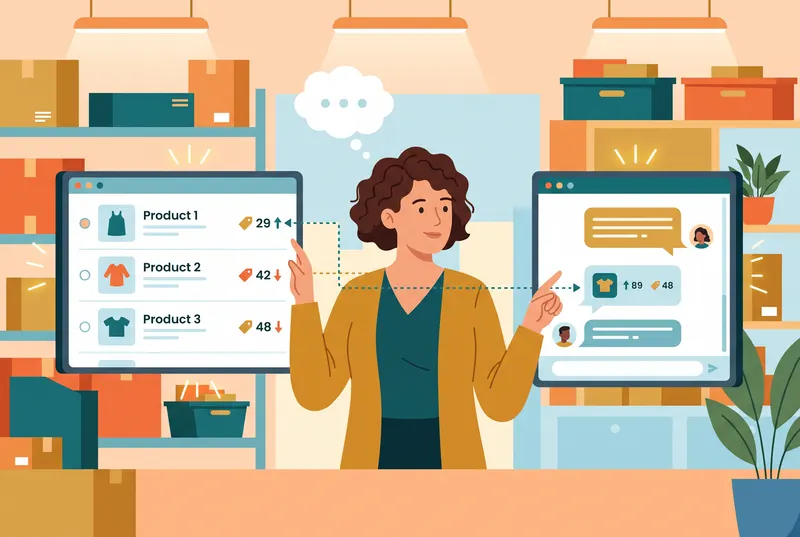
On product and category pages, focus on selection questions. If a catalog is connected, the assistant can show product cards in chat with an image, price, and an add-to-cart button that fires the site’s own JavaScript. For visitors, seeing an actual product available on the site is a strong practical signal that the conversation is connected to the store rather than producing generic recommendations.
That makes product recommendation chat ecommerce use cases more credible, but only when the catalog feed is connected. A basic script installation without a catalog feed will not produce product cards.
On help and policy pages, prioritize source-backed answers and a visible human path. On pricing or service pages, use buttons to guide visitors toward the information they need rather than forcing them to formulate the perfect question.
For multilingual website chat, the assistant replies in the language the visitor writes in, with no language setup required. Still review your source material: clear, well-structured information is easier to validate regardless of the visitor’s language.
A practical install checklist
The technical part of installing a chat assistant on a website should be quick, but the credibility work happens around it. The widget uses one asynchronous script tag placed before the closing </body> tag and loads after the page renders. It works with WordPress, Shopify, React, Next.js, and plain HTML through manual script installation. An install checker confirms that the widget is live.
Before publishing, check the following:
- Brand the widget to match the site and choose mobile settings.
- Write a welcome message that matches the page’s intent.
- Import and review the highest-value knowledge sources.
- Test five sourced questions and at least one unknown question.
- Decide whether AI-only, live agents only, or hybrid mode fits your staffing.
- Add a visible handoff route for questions that need a person.
- If you sell products, connect the catalog before promising a product finder experience.
- Review logged AI answers after launch and improve the underlying content when gaps appear.
Analytics can show page views, widget opens, chats started, AI performance, and flow conversion by site. Use these signals as diagnostics, not as proof that the chat is trusted. For example, a high number of opens with few meaningful conversations may point to weak opening copy, missing source content, or an unclear next step.
What to compare before you buy
If you are searching for a Tidio alternative, an Intercom alternative for a small store, or weighing Crisp vs live chat AI, compare first-interaction mechanics rather than just feature lists. Competitor capabilities and pricing change, so verify each directly during evaluation.
| Evaluation area | What to verify | Evidence to look for in Owni |
|---|---|---|
| Install speed | Does the tool have a clear installation path and a way to confirm it is live? | One async script tag, an install checker, and support for common site stacks through script installation. |
| Answer credibility | Can a visitor inspect where an answer came from, and does the assistant admit uncertainty? | Exact source links on answers and an honest fallback. |
| Human control | Can you choose AI-only, agent-only, or handoff-based coverage? | AI-only, live agents only, and hybrid modes, plus shared inbox assignment. |
| Ecommerce catalog | Can it present real products rather than generic suggestions? | Connected catalog product cards with image, price, and add-to-cart action. |
| Pricing clarity | Are AI allowances, sites, seats, flows, and history stated clearly before purchase? | Published plan allowances from Free through Pro, with monthly pricing shown. |
A fast install is useful, but it is not the same as a trustworthy launch. For a first evaluation, install the widget on a high-intent page, load a controlled set of source material, test real visitor questions, and make the human route visible. For a more detailed test plan for evaluating an AI shopping assistant, include product answers, recommendations, stock and price question tests, and installation details. That is a more credible starting point than trying to automate every conversation on day one.
Sarah Chen has spent eight years scaling support teams at ecommerce brands. She writes about handoffs, staffing, and what actually reduces ticket volume.
FAQ
The strongest early signals are a widget that matches the site, answers grounded in business content with a visible source link, and an obvious way to reach a person when needed.
Begin with high-intent material such as product pages, FAQs, shipping and returns policies, comparison guides, and compatibility information. Then test sourced questions and improve content gaps found in conversation reviews.
When a catalog is connected, the assistant can show product cards in the conversation with an image, price, and an add-to-cart button. Without a catalog feed, product cards are not available.
Use AI-only when questions are well-covered by documented content. Use hybrid chat when visitors may need exceptions, account-specific guidance, or judgment from a teammate. Make the handoff route clear either way.