How to Evaluate an AI Shopping Assistant Before You Install It
James Ortiz
Solutions Engineer
7 min read

Most AI chat demos look good for the first thirty seconds.
Ask, “What do you sell?” and you get a polished answer. Ask something a real shopper asks — “Will this jacket fit over a hoodie?”, “Which replacement filter works with model X?”, or “Is the blue medium actually available?” — and the useful differences show up quickly.
If you are looking to add AI chat to your site, do not start with the widget’s colors or the size of its floating bubble. Start with a small test pack based on the questions that currently interrupt your product team, inbox, or checkout flow.
The goal is not to find a chatbot that sounds confident. It is to find one that knows when it has evidence, can guide a visitor to a relevant item, and does not create an inventory problem by guessing.
Start with the questions visitors ask before buying
Product-page questions ecommerce teams see repeatedly tend to fall into three groups:
- Facts: dimensions, materials, compatibility, delivery terms, returns, care instructions, included accessories.
- Choice: which size, bundle, variation, or product suits a stated need.
- Availability: whether a specific variant can be bought right now.
Build a test set of 12 to 20 real questions. Pull them from chat transcripts, contact forms, search terms, and the notes your team receives from sales. Include awkward wording and incomplete questions. Shoppers rarely ask in clean database language. Chat transcripts can also reveal which pages and policies are creating avoidable support questions.
For each question, write down the expected source of truth. A size answer might belong on a product page. A compatibility answer may sit in a PDF manual. A shipping cutoff may live in an FAQ. A stock answer may need a current inventory system rather than a page that was published last week.
That last distinction matters. A chatbot that knows product catalog details is not automatically able to check live availability. Ask the vendor exactly where availability comes from, how variant-level stock is handled, and what the assistant says when it cannot verify an answer. If the answer is vague, test real-time stock and price questions before you install with an item that changed availability recently.
A safe assistant should say it cannot confirm stock rather than turn “usually available” into “yes, add it to cart.”
Test whether product answers are grounded, not merely plausible
When you train an AI chatbot on website content, test its evidence as closely as you test its wording.
Give it three straightforward product questions, then three questions with a trap. For example:
- “Does the 1-litre bottle fit in a standard cup holder?”
- “Can I use this cable with a 2021 device?”
- “Is the travel case included?”
- “Does it come in teal?” when teal is not a listed option.
- “Can I return a personalized item?” when the policy has an exception.
- “Does this fit model 418?” when the page only lists model 417.
A good result is not always a direct answer. Sometimes the correct result is a precise fallback: the assistant does not know, asks for the missing model number, or sends the shopper to a human. A useful fallback preserves the question and routes it somewhere accountable.
This is where source links are useful. Owni answers from the knowledge sources you provide — pasted text, FAQ entries, imported URLs, or uploaded PDF, Markdown, CSV, and TXT files — and each answer links to the exact source page. That lets a store owner review whether the answer came from the return policy, the actual product page, or somewhere irrelevant. Designing answers with help-article citations makes that guidance easier for visitors to verify. The quality still depends on what was indexed; a clean chat interface cannot repair an incomplete size guide.
I recently worked through a crawl issue for a retailer with 14 colour swatches on one product page. The visible page described the base product clearly, but the size guide was a separate PDF and the variant labels were abbreviated. The sensible test was not “Can the bot describe this product?” It was: can it cite the guide for fit, avoid inventing a colour-specific detail, and admit it cannot verify the selected variant’s stock? That is the level of test that prevents a convincing demo from becoming a support headache.
Separate recommendations from inventory claims
An ai product finder on an online store should narrow choices based on what the visitor says. “I need a quiet desk fan for a small bedroom” is a recommendation request. “Do you have the white version in stock today?” is an availability request.
Treat them as separate acceptance tests.
For recommendations, check whether the assistant can:
- Identify the shopper’s constraint: budget, use case, compatibility, size, or preference.
- Present a short, relevant set rather than a vague list of categories.
- Explain why each item fits the request.
- Let the visitor act on the suggestion without manually searching for the product again.
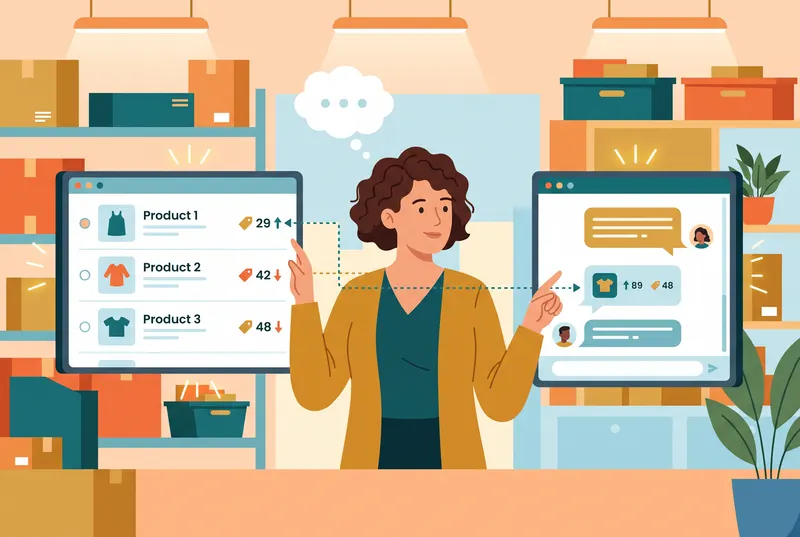
With a connected catalog, Owni can show product cards during a conversation with an image, price, and an add-to-cart button that fires your site’s own JavaScript. That is useful for product recommendation chat ecommerce use cases, but only after the catalog feed is connected. A bare script installation will not create product cards by itself.
For availability, use a much stricter script. Test an in-stock item, an out-of-stock item, a low-stock variant, and a product whose status changed during the day. If a provider has a live catalog or inventory lookup, have them demonstrate the exact query and failure behavior. If it does not, configure the experience so the assistant does not promise availability it cannot see.
That may sound conservative. It is cheaper than having a visitor reach checkout after chat has assured them that a discontinued variation is ready to ship.
Test the handoff, not just the bot
The best AI chatbot for a website is rarely the one that tries to answer every question. Product advice can be automated; exceptions often should not be.
Ask what happens when the shopper writes:
- “I need this delivered before Friday.”
- “My order has not arrived.”
- “Can you match this quote?”
- “I cannot tell which replacement part I need.”
For an AI chat widget for website use, the handoff should preserve context. In hybrid mode, the assistant can reply from the knowledge base and send harder cases to a shared team inbox, where chats can be assigned and marked open, pending, or closed. Test the transition yourself on mobile and desktop. Check whether the human sees the full conversation, not just the last message.
Also test your multilingual website chat case with the languages your customers actually write. It is not enough for the interface to be translated. The assistant should respond in the visitor’s language, and its underlying source material must still be understandable and accurate for that market.
Compare the installation path before choosing a vendor
A tidio alternative, an intercom alternative for small store, or a crisp vs live chat ai comparison often becomes a feature checklist. Add one practical row: “How do we launch this safely?”
For a first test, you need a site where you can edit the page markup, a short list of approved knowledge sources, and a person who can answer catalog and policy questions. You do not need to rewrite every help article before testing.
Check these implementation details:
- Does the widget load asynchronously after the page renders?
- Can you restrict it to registered domains, including staging and subdomains?
- Can you test on a product page without changing templates across the whole site?
- Can the team inspect conversations and review AI answers after launch?
- Can you measure widget opens, chats started, AI performance, and flow conversion by site?
To install chat assistant on website pages with Owni, the initial setup is one async script tag before </body>; it works on WordPress, Shopify, React, Next.js, and plain HTML, and an install checker confirms the widget is live. The widget is locked to registered domains, with up to 10 domains available per project. That makes a staging test practical without exposing the chat on an unapproved domain. The first message and quick questions should also be set up before visitors start asking.
Do the evaluation on five real product pages, not a generic homepage. If the assistant can cite the right source, recommend an item from a connected catalog, decline to guess at stock, and hand off a hard question with context, you have enough evidence to move from trial to installation.
FAQ
Prepare 12 to 20 real visitor questions, the pages or documents that contain the correct answers, and a small set of products for recommendation testing. Include at least a few questions where the right answer is “I do not know” or requires a human.
A basic Owni installation takes about two minutes: add one async script tag before the closing body tag, then use the install checker to confirm the widget is live. Time spent preparing knowledge sources, catalog data, and test questions is separate.
Only if it has access to a current availability source. Test this separately from product recommendations, especially for variants and recently changed stock. If the assistant cannot verify availability, it should say so rather than make a promise.
Ask questions whose answers appear in specific product pages, policies, and documents, then inspect the cited source. Also ask trap questions about unavailable options or unsupported compatibility to see whether the assistant falls back honestly.