How to Ask for Just Enough Context in Website Chat
A visitor opens chat and types: “My order hasn’t arrived.”
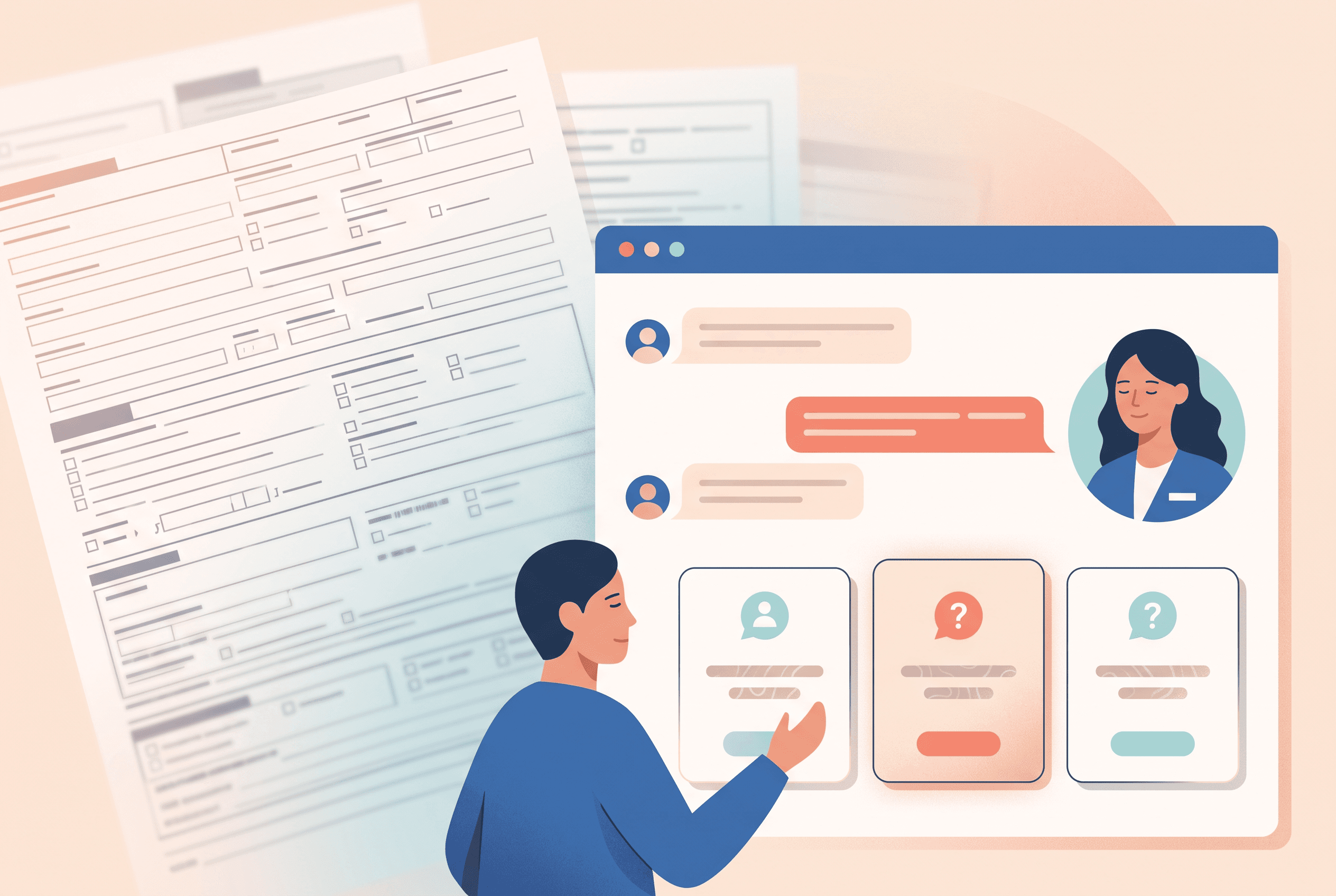
The tempting response is a miniature support form:
- Name
- Order number
- Shipping address
- Product
- Date ordered
- Description of the problem
That is efficient for the support team only if the person actually completes it. In chat, a long first request often creates the opposite effect: the visitor feels they have been handed homework after asking for help.
The better goal is not “collect all the fields.” It is “collect the next piece of information that changes the path.” Setting up that first exchange well is the focus of Install an AI Chat Assistant That Starts With the Right Question.
That distinction makes chat feel like a conversation rather than a ticket form wearing a chat bubble.
Start with the decision, not the data
Before writing any intake question, ask what decision the answer will enable.
For an order problem, the first decision may be whether the visitor needs shipment tracking, a delivery investigation, a cancellation, or a human who can review an exception. You do not need their address to make that first split.
A useful opening might be:
I can help with that. Is your order late, marked delivered but missing, or something else?
Three choices are easier than an empty “Please describe your issue” box. They also produce structured context without making people decode your internal support categories.
This pattern works because each answer has a job:
| Visitor message | First useful question | What it changes |
|---|---|---|
| “I can’t log in” | “Are you seeing an error, or have you forgotten your password?” | Troubleshooting path |
| “Can I return this?” | “Has the item been delivered yet?” | Policy and next action |
| “The price looks wrong” | “Which product or page are you viewing?” | Page or product investigation |
| “I need a quote” | “What are you trying to buy or arrange?” | Routing and qualification |
If the answer does not change a response, route, or action, it probably does not belong in the opening intake.
Ask in layers
A good chat intake has layers. The first layer identifies the issue. The second gathers the minimum detail needed to resolve it. The third appears only when the situation requires it.
Consider a visitor who says, “I was charged twice.”
A clumsy version asks for full contact information and transaction details immediately. A layered version might go like this:
- “I’m sorry you’re dealing with that. Do you see two separate charges, or one charge plus a pending authorization?”
- “Which order was this related to?”
- “Could you share the email used for the order so the team can find the right record?”
The first question avoids treating two different payment situations as one. The second connects the issue to a specific purchase. The email comes later, when it has an obvious purpose.
That last point matters. Visitors are more willing to share personal details when the request is timely and explained. “Enter your phone number” feels extractive. “What is the best number for a teammate to call if chat disconnects?” has a clear reason.
Let the visitor’s first message do some work
Many chat flows waste information the visitor has already supplied.
If someone writes, “I ordered the walnut desk last Thursday and received a damaged leg,” do not ask, “What product did you order?” The chat should acknowledge the detail and move to the uncertainty that remains:
Thanks — was the outer packaging damaged too, or only the desk leg?
This is partly a writing problem and partly a flow-design problem. Scripted choices are useful for common, ambiguous openings. They become irritating when they repeat something plainly stated in the message.
Use buttons for high-frequency forks, especially where visitors may not know your terminology. Use a free-text reply when the detail is inherently specific: an error message, a product name, or an explanation of what happened.
The best intake is adaptive in this modest sense: it asks less when the visitor has already given more.
Keep choices small and human
Button choices can lower the effort of starting a conversation, but too many choices turn the chat into a menu tree.
A practical ceiling is usually three to five options at one moment. More than that forces scanning, especially on a phone. If there are eight possible issue types, group them around what the visitor is trying to do rather than around your internal queue structure.
For example, replace this:
- Billing dispute
- Delivery exception
- Technical issue
- Account access
- Product information
- Cancellation
- Return request
- Other
With this:
- Help with an order
- Help choosing a product
- Account or website problem
- Something else
The next message can narrow the category. The visitor should not have to understand your department map before receiving help.
Also write choices as the visitor would say them. “My order is late” is better than “Fulfilment status.” “I can’t sign in” is better than “Authentication issue.” This sounds obvious until a support team copies labels from an internal dashboard into a public chat flow.
Make personal-data questions earn their place
Names, emails, and phone numbers are useful when a team needs to follow up, locate a conversation, or match an order. They are not neutral requests. Every extra field introduces friction and, for some visitors, suspicion.
Ask for the smallest identifier that can move the case forward. If an email is enough, do not ask for email and phone. If a human can first answer a policy question without identifying the visitor, do that before presenting a lead form.
When order lookup is involved, be precise about what is needed and why. For example, an OpenCart shop using Owni’s module can require both an order number and the matching email together for order lookup. That paired check is safer than asking for a loosely described order detail, but it belongs only in the order-specific branch, not as a universal welcome screen.
For lead-oriented chats, use a similar rule: qualify before collecting. A visitor asking about enterprise procurement may reasonably be asked for a work email after they have described the need. Someone asking whether a product comes in blue should not hit a contact form before receiving the answer.
Build escape hatches into every intake
Not every visitor can answer your first question. They may not have the order number, may be browsing for someone else, or may simply be too frustrated to pick the “right” category.
Add an honest escape route:
- “I’m not sure”
- “Something else”
- “Talk to a person”
These are not failures in a flow. They are evidence that real problems have edges.
In a visual chat flow, button choices can collect the initial intent, then hand off to a human when the issue falls outside a supported path. A lead-capture form can collect a name, email, or phone number only where follow-up is actually necessary. Per-flow analytics for views, clicks, submits, and completions then show where people stop responding.
If many visitors choose “Something else,” do not remove the option to make the numbers prettier. Read the conversations. You may have missed a common reason people open chat, or your labels may be written from the company’s perspective instead of theirs.
Review drop-off like a support symptom
A high abandonment point is often treated as a conversion problem. In support chat, it can be a clarity problem, a trust problem, or a timing problem.
Look for patterns such as:
- Visitors disappear after being asked for an email before receiving any help.
- People repeatedly type free text instead of using your buttons.
- The same clarification question appears in human replies after the flow ends.
- Operators reopen chats because the intake captured a category but not the one detail needed to act.
Change one question at a time. Replacing “Please provide your details” with “Which email did you use for this order?” is a meaningful test because the reason is concrete. Rebuilding an entire flow after a few difficult chats usually hides what actually improved.
The useful test is simple: can a visitor reach the next helpful response after giving one small piece of context? If not, the chat is still behaving like a form.
FAQ
Usually one question is enough to identify the first path. Ask the next question only when its answer changes the response, routing, or action.
No. Ask for an email when it is needed to locate an order, send follow-up, or connect the visitor with a team member. A general question can often be answered before collecting contact details.
Buttons work well for common, simple forks such as late order versus missing order. Free text is better when the visitor needs to provide a specific error, product name, or explanation.
Include an escape route such as “Something else,” “I’m not sure,” or a human handoff. Review those conversations to find missing categories or unclear wording.
Check where visitors stop replying, which buttons they avoid, and what agents still need to ask after the flow. A question that produces drop-off without improving resolution should be shortened, delayed, or removed.